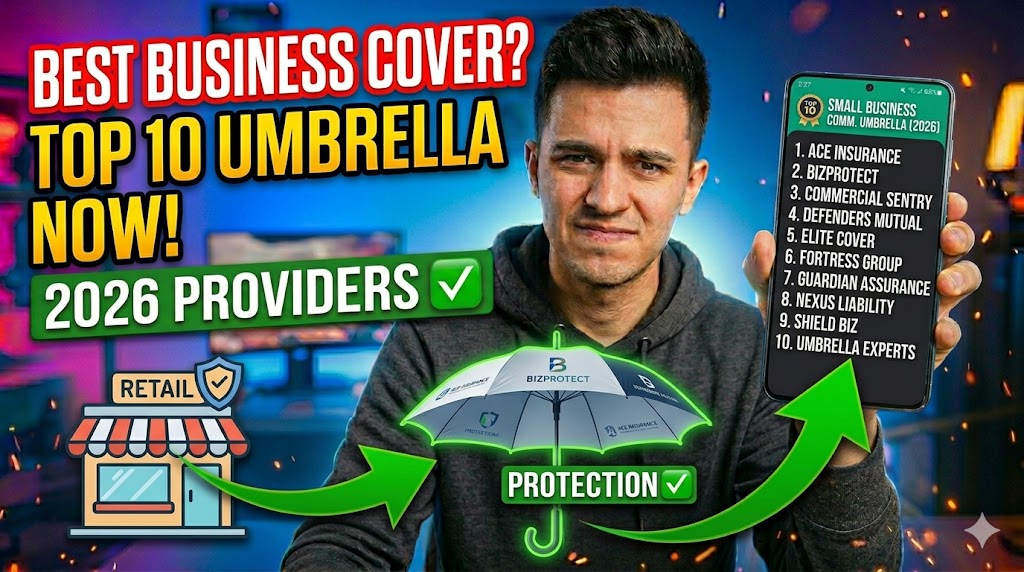
When a catastrophic claim hits your small business, standard liability limits can vanish in the blink of an eye. Many business owners discover too late that a single severe slip-and-fall accident, a major delivery fleet collision, or an aggressive advertising injury lawsuit can easily surpass standard $1 million primary policy caps. When a judgment exceeds those initial limits, it exposes your personal savings, business infrastructure, and future revenue streams to total liquidation.
This dangerous vulnerability usually stems from unexpected legal cost inflation, soaring medical settlement demands, or dense operational risk exposures unique to growing enterprises. Fortunately, a structured commercial umbrella policy acts as a vital secondary safety net, absorbing these devastating overages before they trigger corporate bankruptcy. This comprehensive evaluation and procurement guide breaks down the top-tier insurance providers of 2026, details tactical implementation strategies, and explains exactly how to secure maximum protection for your operational bottom line.
Strategic Parameter Selection Matrix
| Technical Detail | Specification / Requirement |
| Target Platform / Audience | US Small Business Owners, LLCs, Independent Contractors, and MSMEs |
| Coverage Type | Secondary Commercial Umbrella Liability & Excess Form Layering |
| Primary Underpins Required | Commercial General Liability (CGL), Commercial Auto, or Employer’s Liability |
| Typical Policy Limits | $1 Million to $15 Million (Tiered according to aggregate operational risk) |
| Difficulty Level | Intermediate (Requires accurate alignment of primary policy aggregate limits) |
| Estimated Settlement / Placement Time | 24 to 72 Hours (From online application ingestion to formal binding) |
5 Practical Steps to Evaluate and Bind the Best Umbrella Carrier
1. Match Your Underpinning Limits to Carrier Underwriting Thresholds
Before approaching a premium tier-1 commercial umbrella carrier, you must ensure your baseline insurance policies meet their structural underlying minimums. Commercial umbrella forms do not sit in an operational vacuum; they dictate strict mandatory baselines on your current general liability and commercial auto caps. If your primary limits are too low, the umbrella policy will not kick in, creating an expensive and hazardous gap in your defense.
- Step A: Gather your current insurance declarations pages for General Liability, Commercial Auto, and Employer’s Liability to review your active thresholds.
- Step B: Verify that your primary general liability occurrence limit is at least $1,000,000. Most top-tier umbrella underwriters will flatly reject applications if primary limits are parked at lower tiers like $300,000 or $500,000.
- Step C: Check your commercial auto policy limits to ensure compliance. Carriers like Progressive and The Hartford require a $1,000,000 combined single limit (CSL) to anchor an overarching umbrella tier securely.
2. Compare the Top 10 Commercial Umbrella Carriers of 2026
Select your carrier based on industry specialization, AM Best financial strength ratings, and online platform accessibility. Choosing the wrong provider can lead to denied claims or overpaying for unnecessary coverage features. Below is an exhaustive breakdown of the top 10 choices dominating the small business ecosystem in 2026.
- 1. The Hartford: The overall gold standard for small businesses. They feature exceptional “A+” AM Best ratings and seamlessly extend underlying liability forms written by different external carriers, offering immense flexibility.
- 2. Liberty Mutual: Best for highly targeted, industry-specific Business Owners Policy (BOP) bundling. They offer 12 distinct, tailored industry frameworks ranging from food service to heavy construction.
- 3. Travelers: Ideal for businesses handling complex logistics, professional exposures, or substantial regional commercial auto fleets that demand robust multi-state frameworks.
- 4. Next Insurance: The premier digital-first choice. Best for micro-businesses and independent contractors who need an instantaneous online application process and immediate digital certificates of insurance (COI).
- 5. Chubb: Geared toward luxury niches, specialized medical practices, and high-net-worth commercial entities requiring massive, customized capacity limits up to $15 Million and beyond.
- 6. Nationwide: Offers unmatched financial stability for storefront retailers and Main Street enterprises seeking to bundle public liability with strong multi-state property coverage.
- 7. Hiscox: Specialized for independent consultants, remote digital agencies, and micro-enterprises that require highly flexible, low-cost baseline premiums without bloated policy additions.
- 8. Progressive Commercial: The undisputed industry leader if your small business operates delivery vehicles, heavy trucks, or contractor fleets requiring deep underlying auto wrappers.
- 9. CNA Financial: Best for tech firms and specialized manufacturers requiring specialized product liability extensions built directly into the excess layer.
- 10. Cincinnati Insurance: Renowned for their highly personalized, independent local agent network and steady, non-audited multi-year policy terms that keep overhead predictable.
3. Identify and Eliminate High-Risk Policy Exclusions
A common point of operational failure occurs when a business owner assumes an umbrella policy covers every imaginable scenario. You must audit your chosen policy for specific coverage gaps before signing the binding agreement to avoid unexpected out-of-pocket litigation expenses.
- Step A: Review the “Exclusions” section of the prospective umbrella policy form with extreme scrutiny. Standard umbrella layers do not cover first-party commercial property damage, professional errors and omissions (E&O), employment practices liability (EPLI), or cyber breach data losses unless explicit endorsements are added.
- Step B: Check for Self-Insured Retention (SIR) requirements. An SIR functions like a distinct deductible for claims covered by the umbrella policy but completely missed by an underlying primary policy. Ensure this value is clearly negotiated down to an acceptable baseline, typically $10,000 or less, to protect your immediate cash flow.
4. Execute a Structured Digital Bundling Analysis
To maximize premium efficiency and eliminate complex administrative friction, attempt to line up your umbrella policy with your core primary insurance lines under a singular carrier portal. Managing multiple portals often leads to communication breakdowns during an active claim.
- Step A: Log into your primary insurance portal and navigate to the policy management terminal to view cross-policy options.
- Step B: Request a multi-line cross-policy bundle directly from the underwriting dashboard. Merging your General Liability, Commercial Property, and Umbrella coverage under a single provider typically yields a 10% to 15% reduction in overall annual premium output.
- Step C: Verify that the policy renewal cycles align perfectly to the exact calendar date. Misaligned expiration dates frequently lead to dangerous, unexpected coverage lapses where your primary coverage expires before the umbrella layer resets.
5. Finalize the Application with Verified Financial Underwriting Inputs
When filling out the formal application document on Taazamind.com or directly within a carrier system, your operational data inputs must perfectly mirror your latest tax and payroll declarations. Inaccurate data can void a policy during a claims investigation.
- Step A: Input your precise annual gross revenue projection. Underwriters utilize revenue as a benchmark for public liability exposure and market risk.
- Step B: Provide an accurate accounting of your total employee headcount and total annual payroll figures. This metric controls the underlying Employer’s Liability exposure component.
- Step C: Execute the digital signature step, submit your payment, and instantly download your updated Acord 25 Certificate of Insurance explicitly showing your active multi-million dollar umbrella limit tiers.
Frequently Asked Questions
What is the core structural difference between commercial umbrella insurance and excess liability coverage?
While both options effectively raise your overall liability limits, they behave differently in practice. An excess liability policy strictly attaches to a single, specific underlying policy (such as your general liability policy) and mirrors its exact rules, exclusions, and setups. Conversely, a commercial umbrella policy can sit over several distinct primary policies simultaneously (including General Liability, Auto, and Employer’s Liability) and can occasionally fill unique coverage gaps not covered by standard baseline forms.
Can a startup buy a standalone commercial umbrella policy?
No, it is structurally impossible to purchase a standalone commercial umbrella policy. Because umbrella layers are designed specifically to extend existing protection caps, insurance providers require you to maintain active, fully compliant primary lines of insurance before their secondary umbrella framework can legally activate. If you cancel your underlying insurance, your umbrella policy immediately becomes invalid.
How much does a standard $1 million commercial umbrella policy layer cost annually?
For standard low-risk small businesses, such as online consulting firms, localized retail shops, or remote digital agencies, a baseline $1 million commercial umbrella layer is highly affordable. It usually ranges between $400 and $700 annually. This rate scales up accordingly if your enterprise operates heavy vehicle fleets, manages complex construction sites, handles high volumes of public foot traffic, or has a history of prior liability claims.
What happens if my primary insurance policy limits are exhausted during a lawsuit?
The moment your primary policy hits its maximum payment threshold, your commercial umbrella insurance policy activates to cover the remaining balance, up to your chosen umbrella limit. If you do not have an umbrella policy in place, your business is directly responsible for paying the remaining balance, which frequently forces small businesses into liquidation or asset forfeiture.
Does a commercial umbrella policy protect against data breaches and cyberattacks?
Generally, no. Standard commercial umbrella policies extend bodily injury and property damage liability limits. They do not extend cyber liability or data breach policies unless you secure a highly specialized cyber excess endorsement. If your small business handles sensitive client data, you should purchase a dedicated cyber liability policy alongside your umbrella insurance.